• Yahoo in the Brand Universe

    Yahoo is a tale of missed opportunity, a new media giant that acts like a dinosaur as their nimbler rival, Google, runs circles around them.  Yahoo could be so cool – they have Flickr, which is the very model of web 2.0 sites.  The difference, however, is that Google is about empowering users.  Yahoo is about big media telling consumers what they should watch.  We’re just a bunch of eyeballs to them.  Their latest attempt to get back in the game is documented in an article in Variety:

     … it’s focused now on a new strategy it calls “brand universe.” Rather than just searching for exclusive content, Yahoo has identified over 100 brands that are most relevant to its users. It plans to launch new sites that bring together all of the content relevant to each brand from across the Yahoo network, as well as whatever the netco can get from the big media firm behind it.

    Apple is a brand that is very relevant to me.  I’ve been going a trusted set of Apple sites for years to feed my fanboy addiction.  What, exactly, is Yahoo going to bring to the table?  Sites like MacCentral, MacRumors, MacUser, etc…. have the space pretty much tied up.  What could I get from Yahoo that I couldn’t get from them?

  • Stock Photos: Seeing Double

    You’re not crazy. You are seeing the same people over and over again in advertisements, according to this article in The Wall Street Journal. Why? Because it’s a lot easier to use stock photos of people than to go out and take pictures.

    When I worked for AARP, we only had a couple of CDs worth of stock photos of active seniors. We used those people again and again on the web site. No women in walkers for us, no, these were tan couples striding to the tennis court, rackets in hand. Or lithe men hanging off steep cliff faces. Or independent grandmothers on the vacation of a lifetime. We used them so much that I felt like I knew them.

    Imagine my surprise when I began recognizing them in other places, like ads for health insurance and annuities. And why not? We didn’t own them, after all. They were just stock.

    my dad
    not stock…. a real active senior, my Dad

  • The Trustworthy Web Site

    You visit a new web site, whether it’s to find information, do some shopping or make a transaction. How do you know to trust it? According to a recent article by Human Factors International, web surfers evaluate sites primarily on two criteria:

    • Professional-looking appearance
    • Ease of use.

    What that means is that the design and the photos look to be the product of a professional effort – it’s not some MySpace site. And that the site has been designed to make it easy to use – again, it’s not some MySpace site. Web credibility is also a function of relevant content. Basically, this means a web site designed toward user needs.

    What’s interesting is that this web site evaluation process is done in seconds. Visitors get to your page, glance it, and then decide whether it’s a trustworthy web site.

  • Get Real: Have an Enemy

    I’ve been enjoying Getting Real, the book by 37signals (creator of the very cool Basecamp).  The book, which is available online, is ostensibly about best practices in software development.  However, I think its lessons can be applied to other situations, like… life.  For example, they suggest having an enemy.  When building Basecamp, 37signals decided that their app would be the anti-Microsoft Project.  MS Project was the enemy.  MS Project would be the opposite of the beast that is Project.

    Who’s your enemy?  How does having an enemy motivate you?  When starting a project, do you think to yourself, “I’ll show them!”

  • Flickr Camera Finder: Canon Rules

    EOS Digital Rebel XT Usage This Year
    Flickr camera use diagram
    courtesy: Flickr
    Flickr’s Camera Finder is fascinating on several levels. For one thing, it’s shocking the level of dominance Canon has among Flickr members. The Canon Digital Rebel XT (the camera I have) is by far the most popular camera among Flickrites, with the Nikon D70 a very, very distant second. Among point and shoots, the top 5 are all Canons, with the Canon Powershot SD400 the most popular model. But what’s also interesting is that you can click on the names of the camera models and see pictures from Flickr users. Useful to see what kind of pictures a camera can take, if you’re in the market to buy one.

  • Blogs in Government

    The blogging revolution has reached government agencies. I think this about makes it mainstream. Pretty soon, even your grandmother will have a blog. Government webmasters (full disclosure: I’m one of them) have put together a really helpful page on the benefits and challenges of government blogging and what to consider before you pick up the keyboard. Bonus: some example government blogs and the Weather Service’s blogging policy. Policy? This is the government after all ;)

  • Web Workers: Some Bathrobes, Some Not

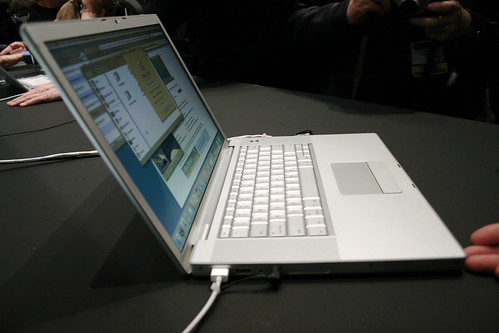
    macbook proIn this charming post by Anne Zelenka, she gives thanks for being able to work in her bathrobe. Web workers don’t need to worry about dressing up or even leaving the home. But what about us web workers who have to bother with showering, putting on pants and trudging into the cube farms? It’s ironic that most in the web field have do their work in a fixed physical location, putting in “face time” with coworkers and trying (futilely) to appear interested during lengthy meetings. It’s so, well, 20th century, that most who build and maintain web sites have to report to an office every day. I’ll give thanks when the work practices of today catch up to the reality of web work. Until then, you’ll find me in my cube.

  • Steal Something of Mine?

    Steal Something of Mine?
    My bike was stolen. I knew I would see it again.
    The Washington Post, June 27, 2002
    (c) Joe Flood

    I knew that I would one day see my bike again. I just knew it. My old Bianchi Broadway had been stolen off the back stairs of my building. I couldn’t believe that someone had gone to the trouble. The mountain bike was five years old, with worn tires, a temperamental chain, and a skein of rust on its exposed parts. To take it, my thief had to go up two flights of winding metal stairs, break the U-lock, and then carry the bike back down.

    Looking out that Sunday morning, at the empty spot along the rail where my bike should be, I was surprised. I shouldn’t have been. Kryptonite named Washington, DC as one of the “Top 10 Worst Cities for Bike Theft.” Nationwide, it is estimated that 1.5 million bicycles are stolen every year. An experienced thief can take your locked bike in about 10-20 seconds.

    I just couldn’t believe that someone would steal something of mine. It hadn’t been an expensive bike, but it was the first bike I had ever owned. And my Bianchi had been with me everywhere. I had commuted on it up the long hill to American University. Ridden on it on pleasant weekend excursions along the C&O Canal. Coasted down the Mall by softball players and tourists. Why would someone steal something of mine? According to the National Bike Registry, the most common reason for bike theft is to pay for drugs. The value of a stolen bicycle is roughly 5-10% of the bicycle’s original retail value. Bikes are even used in lieu of currency in drug transactions.

    But now my bike was gone. I don’t know why I bothered to report it. The police didn’t even come by to take my report; I filed it by phone. And stolen bikes are rarely recovered.

    Yet, I knew I would one day see my bike again. For months afterward, whenever I saw a red mountain bike I would stop and squint at it, looking for identifying characteristics. No, the handlebars are too straight. No, the tires are too narrow. No, the bike looks too new.

    One summer later, I found her. I was walking past a dusty park a couple blocks from my apartment, a little worn square of grass where men sit and drink. I looked over. Something that looked like my bike was leaning against a tree. I stepped into the park. The frame was covered with tacky stickers and duct tape. There was a big gash in the seat. It looked like the gearshifts had been broken off and the tires replaced. But it was my bike. I could tell by the rust.

    The bike’s owner, a short Salvadoran walked over to me.

    “This looks an awfully like my old bike,” I said.

    “No, no, no. Es mine,” he said, pointing to his chest.

    “I’m not saying you stole it, but this is my old bike,” I insisted.

    We bantered in broken English and Spanish.

    “I don’t want no trouble,” he said. He led me out of the park. “You follow, you follow,” he said, waving me on.

    He got on the bike and rode out of the park, me walking behind him. I was waiting for him to take off and pedal away but he never did. My heart was pounding and I was shaky. Where was he taking me? He was careful not to get too far ahead of me, coasting down the sidewalk, looking back at me.

    He turned down an empty alley. I followed. He reached a wooden door in a fence and pushed it open. He waved at me to come in. Me and the new owner of my bike squeezed into a narrow passage between a wall and a garage. The door shut.

    He went to go get someone. I waited in a small courtyard. A man, his neighbor, approached. When he got closer, I saw that he had a Spanish-English dictionary in his hands.

    I explained that this was my bike.

    The neighbor got the story out of the Salvadoran man. He and his friend had found it, among junk, along V Street. They had taken it home and fixed it up. They fixed up bikes they found in the area. The neighbor didn’t know where they got them from but that they weren’t thieves.

    The Salvadoran got anxious during the explanation.

    “Calm down! Tranquilo!” his interpreter said. “He wants you to know that he’s not a criminal.”

    “No criminal, no criminal.” He paced in the little courtyard, looking up into my eyes.

    I didn’t think that he was a criminal. He could have told me to get lost back at the park, or rode off when I was following him. He didn’t have to get his neighbor to try to clear up the situation.

    He offered me the bike. I didn’t want it. The bike was ruined, and nothing like the bike which had taken me everywhere. I had bought another one a few months earlier. I told him that he could keep it, that I didn’t think that he was a criminal.

    “No criminal,” the man said, happy.

    “No criminal,” I replied.

    “Problem solved,” the neighbor added, relaxing.

    The neighbor asked me my name. Joe. His was Joseph. The Salvadoran’s was Jose.

    “Hey, we all got the same name,” Joseph said, beaming. “Joe, Joseph, and Jose.”

    “Joe, Joseph, and Jose,” Jose said, pointing at each of us in turn.

    I squeezed the brakes on my bike one last time and left.

  • Go Hollywood! What’s the Logline for Your Site?

    InternetDay.com, April 1, 2002

    “In the dizzying world of moviemaking, we must not be distracted from one fundamental concept: the idea is king.”
    –Jeffrey Katzenberg

    I can hear the protests already. Creating a web site is not like creating a movie, we don’t need to go “high concept” or any of that other Hollywood marketing fluff. We will build the web site, its value will be obvious, and it will sell itself to the appropriate audience. End of story. FADE OUT.

    Wrong.

    Every year, around 300 movies get released into the crowded multiplexes of America. And they get encapsulated in a sentence or two to make it easier for moviegoers to find what they want.

    Every year, thousands of web sites get launched into the disorderly, low-barrier world of the web. How will your site stand a chance among all these competitors for your customers’ most valuable asset, their time? How will you differentiate your site among this cacophony?

    Just like a movie, you better be able to explain the purpose of your site in a sentence. For those who wish to look down on Tinseltown, you may refer to it as your “elevator speech.” If you can’t explain your site in 15 seconds to a customer, how are you going to get him to visit your site?

    Unfortunately, web development frequently begins with only the vaguest notions of what a site should be about.

    FADE IN

    INT. CEO’S OFFICE
    The CEO of Widgets, Inc., has ordered the construction of a new web site. It’s going to be filled with all sorts of fancy bells and whistles to impress his buddies at the country club. The MARKETING DIRECTOR is nervous.

    CEO
    And I want Java. I read about that.

    MARKETING DIRECTOR
    I’ll get the techies to work on it. But, sir, who’s this site going to be for?

    CEO
    Me.

    MARKETING DIRECTOR
    Well, yes, you, obviously. But who is the audience? Customers? Investors? The press? What are we trying to do here? Before we start spending money, shouldn’t we figure that out?

    CEO
    All of the above. And everything. Now get out.

    INT. CEO’S OFFICE
    6 MONTHS LATER
    The new web site for Widgets, Inc., has been launched to crushing silence. It’s another bland, corporate web site.

    CEO
    Can you explain to me why we have no traffic?

    MARKETING DIRECTOR
    I’ve thought about that, sir. And I think it’s because our web site has no identity. Our press releases, brochures, banner ads, and emails just talked about the “online home of Widgets, Inc.” They provided no compelling reason for anyone to visit.

    CEO
    You better have a plan.

    MARKETING DIRECTOR
    The most popular feature on the site is designing your own widgets.

    CEO
    It’s also the most profitable.

    MARKETING DIRECTOR
    I propose rebranding the site to appeal to customers, highlighting our widget customization feature. Our logline will be, “Widgets lovers, design widgets in seconds at the Widgets web site!”

    CEO
    Why didn’t you think of that in the first place?

    FADE OUT

    A good log line will help you focus your site around a single organizing principle. For example, eBay is “The World’s Online Marketplace.” Clickz.com provides news and viewpoints from the Internet marketing and advertising industry. The Onion is America’s Finest News Source. All these sites concentrate on one big idea which they do well.

    Here’s a tool to help you get started.

    Sample web site:

    url: where’s the site going to be located?

    title: what are you calling your site?

    logline: what’s the elevator speech for the site?

    audience: who’s the audience?

    Think this is simplistic? It is, and necessarily so. Oftentimes, like in the example above, web sites get built with many different consituencies in mind and with many different purposes. The result is design by committee and a web site that pleases no one, especially visitors.

    Creating a good log line is just the first step in marketing your web site. This first step is also the most important one. Taking the time to think about the unique benefits of your site will help focus the work of your web team on delivering a quality, unique site. It will also make later marketing efforts considerably easier and more effective.