I recently had the opportunity to talk about how to write a short story before a virtual class of high school kids. I discussed where ideas come from, the two types of short stories, how to get started and how to edit your own work.
In my talk, I used examples from my own short stories, including my book LIKES and the award-winning Apartment 101.
I put the presentation on SlideShare. Feel free to share!
Sweating and gulping beer, I watched Steph tap dance in a nearly empty apartment building on the edge of downtown DC. The structure was going to be gutted and gentrified but first one last party on a steamy summer evening. No need to worry about the neighbors because there were no neighbors – everyone else in the building had moved out.
And I owe it all to photography. I met Steph through InstagramDC, a community for photographers in Washington, DC. We get together for instameets, happy hours and other events – it’s a photo collective.
Through a collective like InstagramDC you can expand your skills, pool talents and, most importantly, meet new people. If you’re creative, inspiration comes from new experiences, such as watching a friend tap dance on a sweaty evening in an abandoned building.
In this listicle for the Capital Weather Gang, I share my tips for creating a good weather photo. It’s about composition, knowing your camera, including people, getting out of the car and telling a weather story.
The photo editor included lots of bike photos – that’s what I’m known for as a photographer. A bike is also how I get around the city and am able to capture so much interesting imagery.
I’m a huge Capital Weather Gang fan. It’s the best part of the paper, IMHO. I was glad to share my knowledge with their readers.
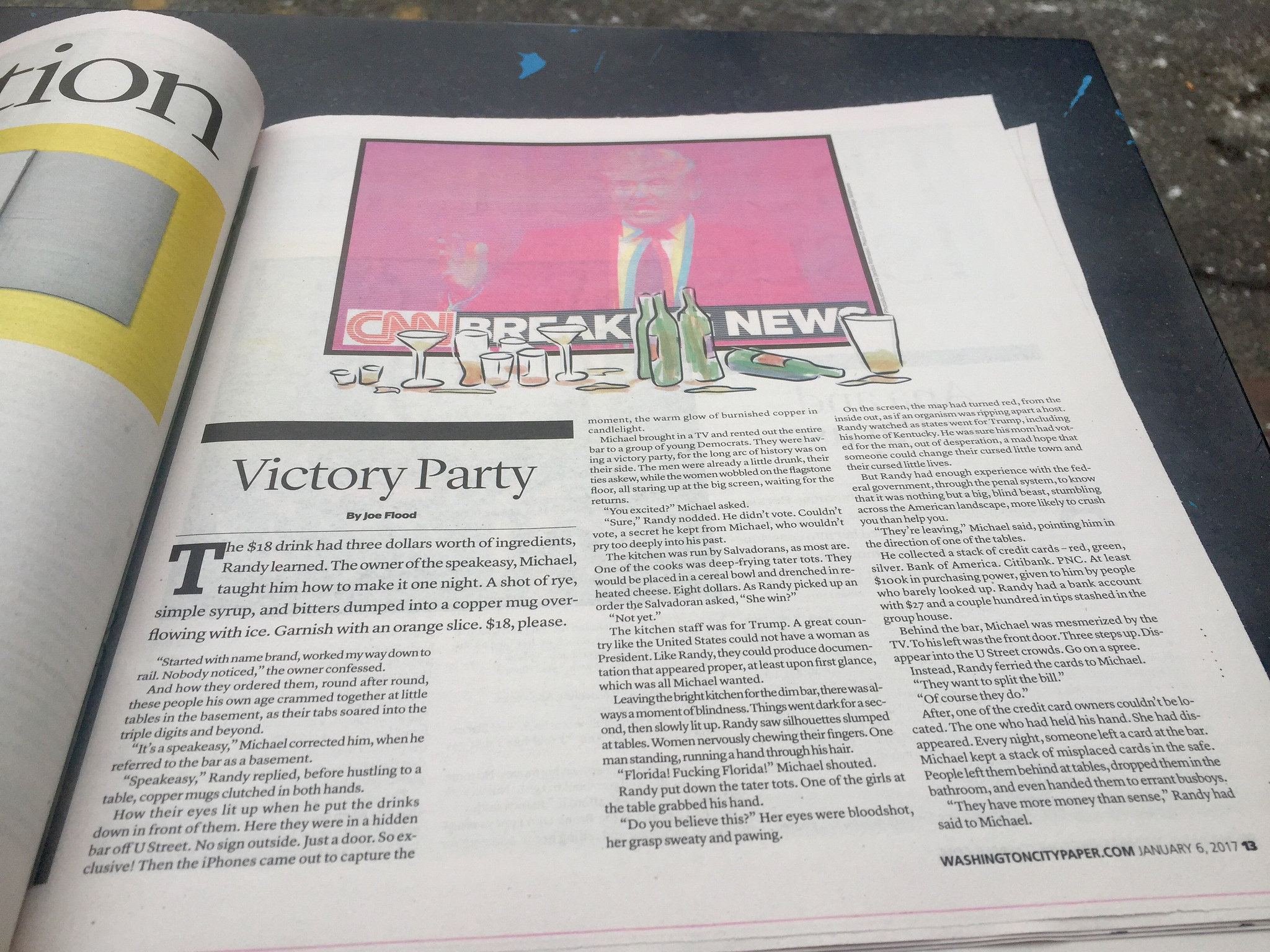
In my short story Victory Party, which won the City Paper Fiction Competition, I portray a Washington shocked by the Trump victory – and one person who’s happy about the result.
Election 2016 was an event that traumatized the American psyche. I wasn’t the only person who processed this horror through fiction. A majority of the submissions to the City Paper contest concerned Trump, as I learned during a reading at Kramerbooks.
I assumed the worst was over. A horrible punch to the gut but then life in Washington would resume along the contours of previous experience. Trump would rise to the occasion and become a normal Republican like Bush.
I was wrong. Realized it during his American Carnage inauguration speech. Everything went downhill from there, a year of outrages culminating in the firing of James Comey. Now, we’ll be lucky to survive 2017 without Trump kicking off war on the Korean peninsula.
During the year, I wrote a novel – The Swamp. My fictional depiction of the Obama era seems quaint. The book presents a scenario I thought outlandish, in which a political groundswell demands that the nation’s capital be moved out of DC. Out of Washington, I called it. But this fictional future reads like a best-case scenario now.
Thinking back on my short story, Victory Party, what would my protagonist make of the past year? My ex-con Randy was happy, the Trump victory representing revenge upon the elite class, through he’s wise enough to know it won’t last. One year later, it hasn’t, and I imagine him trying to stay honorable in very dishonorable times.
We write to make sense of our times, trying to impose narrative on chaos. Washington wrote following the Trump victory. Washington continues to write as the nation unravels.
In your head, it’s perfect, the Great American Novel, a book destined to be a classic. All you have to do is write it down.
But an idea is not a real thing. It’s nothing. Saying you have a great idea for a book is like saying you have a great idea for a jet fighter. It’s a fantasy. Only by taking your story and actually telling it do you create art.
Your book will be imperfect. Shockingly so, which is why most people never get around to creating art. It’s safer to be an imaginary artist than a real one.
But, if you’re an artist, you get your art out the door and into the world. “Real artists ship,” as Steve Jobs said. You become a writer by writing, not by dreaming about it.
National Novel Writing Month in November is an excellent time to start your creative journey. Join a global community of people striving to write a novel. Challenge yourself to pick up the literary habit, find the solace of creating something new and make a real contribution to the world.
The objective during NaNoWriMo is to write a novel – not necessarily a good novel. NaNoWriMo is about quantity, not quality, with a single goal to attain: 50,000 words. That’s 1667 words a day.
The novel can be crap. In fact, it probably will be crap. Expect it to be crap. Giving yourself permission to write crap is enormously liberating.
And you can always fix it. Many great novels have emerged from painful first drafts. Every book gets revised. Hemingway wrote 47 different endings to A Farewell to Arms.
I tend to write and cut. For my short story, Victory Party, which won the City Paper fiction contest, I wrote it over a couple of days but then spent the next month picking away it like a turkey carcass, deleting anything that sounded like exposition until only the bones remained. You can fix stories but first you have to write them.
My first novel, Murder in Ocean Hall, began as a joke. After three years at the National Oceanic and Atmospheric Administration, I was going to take some time off to write a big, serious novel about 9/11. No pressure.
But, at my going away party, I joked that I was going to write a book called Murder in Ocean Hall. I had learned a lot about the big egos of ocean explorers while at NOAA, as well as interesting background behind the construction of the Ocean Hall exhibit at the Smithsonian. I could pair these interesting stories with my street-level knowledge of DC beyond the monuments to create a murder-mystery.
Write what you know.
Plus, writing a mystery was a way of taking pressure off my own artistic ambitions. I wasn’t writing serious literature. Instead, I was writing genre fiction. It didn’t have to be the Great American Novel; readable would suffice.
I don’t know why people say writing is painful. “Just open a vein and bleed,” according to Hemingway.
But, for me, writing is a joy. Starting during NaNoWriMo, but continuing long after, I went to a coffee shop and made stuff up, piling up words and solving problems as I built my book, learning how to write a novel over endless cups of java.
Is Murder in Ocean Hall any good? Does it matter? I had fun writing it and I enjoy seeing it on my shelf.
Which is why you should NaNoWriMo. You’ll do what few people have – actually write a book rather than just talking about it. But also because writing is a fun and creative activity with its own rewards. And you can do it while hanging out in coffee shops. That’s why I write.
When an errant drone crashes into the White House, it triggers a chain of events that leads to the end of the country as we know it.
Welcome to THE SWAMP, my new novel mocks the city that America has come to hate.
THE SWAMP begins on Christmas Eve, when a drone crash causes a security scare at the White House. Fox News screams, “How can we keep the President safe?” A crackpot idea from a cynical TV correspondent – let’s move the nation’s capital to an underground bunker – becomes an uncontrollable political movement. Can the President and the rest of official Washington contain this red state rebellion or will it swamp them all?
From mommy bloggers to scheming bureaucrats, THE SWAMP is a love letter to this city – and a wish for its destruction – packaged together in a black comedy reminiscent of Christopher Buckley and Evelyn Waugh.
It was a very wet snow, typical for DC, one of those storms lingering on the edge of the rain/snow line. A damp, cold and miserable day.
But I went out anyway, not being one to sit inside, no matter the weather. Perhaps that’s why I love photography so much – it gives me an excuse to get out and explore the world.
Ice formed on the hood of my jacket as I trudged up Massachusetts Avenue. When it snows, I enjoy doing a loop around the historic mansions of the Kalorama neighborhood.
In my photography, I like classically-framed compositions. I like strong lines and contrast. I like photos that tell a story, ones that you draw you into the frame.
Which is why I love the Spanish Steps so much. With wet flakes falling on the marble steps, and one streetlight golden, the scene looked like a fairy wonderland. I took off my gloves, pulled out my Canon Rebel, and took this photo.
One of the benefits of being an amateur is that my photos are for myself. I took this photograph with no expectation of anything other than producing a pleasing image.
A couple of years later, I was walking through Mitchell Park, the green jewel that sits atop the Spanish Steps. There was a flyer for a photo contest, sponsored by the Friends of Mitchell Park. Free to enter, prizes unspecified. Remembering my photo in the snow, I entered it into the contest.
Several months later, I received an email telling me that I won one of the categories and would I come to a reception at the residence of the French Ambassador. Sure! There I was trudging up another hill in Kalorama, this time to a Tudor mansion, after a couple of $4 beers at Glen’s Garden Market.
Inside, it was like a scene from the Great Gatsby, though the crowd was older, as supporters of the park enjoyed champagne and canapés. The French Ambassador gave a short speech, thanking those present for their support in making Mitchell Park such a special little park. DC parks often depend on outside financial support for their operation.
The other two winners and myself were then recognized and given prizes. Mine was a wine tasting for six! That’s way more than I expected from a free contest.
The rich are different than you and me, according to F. Scott Fitzgerald. Mitchell Park has some illustrious neighbors, including the Obamas, Ivanka Trump and Jeff Bezos. Topics at the reception included speculation on how much the Amazon founder paid for his mansion. While the Mitchell Park supporters were not as wealthy as Bezos or Trump, they were a world away from my $4 beer lifestyle.
But money can’t get you everything. Money can’t buy the experience of pulling on your boots and venturing outside in terrible weather. All the riches in the world won’t put you in front of the Spanish Steps on a snowy afternoon, as you line up the perfect shot, your fingers slowly freezing. That’s something that you have to do for yourself.
My short story, Victory Party, won First Place in the City Paper Fiction Issue. Since then, a number of friends have asked me about the story. Where did the idea for Victory Party come from? How did I write it? Why did I write it?
Here are answers to Frequently Asked Questions. It’s the story of a story – how Victory Party got made.
Idea
The deadline for the City Paper contest was not long after the Presidential Election. It was a natural subject. According to Mary Kay Zverloff (author of Man Alive!), who judged the competition, the vast majority of short story submissions dealt in some way with the election.
I was surprised, like most people, by the depth of Trump’s support. This election was Hillary’s to win – all the polls agreed. But, clearly, there was a secret class of Trump supporter, people in the shadows, who kept their opinions to themselves.
Who were they? What motivated them? Exit the DC bubble and it’s not hard to find folks suffering from hard times. As I wrote in Victory Party, these were people who:
voted for the man, out of desperation, a mad hope that someone could change their cursed little town and their cursed little lives.
But what would it be like to be a Trump supporter in Washington, where 96% of people voted for Clinton?
Conducting research with The Emperor’s Clothes at McClellan’s Retreat
Setting
There are a lot of bars in my fiction. Write what you know! It’s the default setting for a Joe Flood story. I find bars to be interesting places that bring all manner of people together. Having talked to a few bartenders, I’m also fascinated by the business of bars, how a couple dollars worth of booze gets magically transformed into an $18 drink.
DC has seen a rise in this “cocktail culture” over the past few years, as the loveable dives of my youth give away to exclusive speakeasies. I decided a ridiculously hipster bar would make a good locale for my story, the better to illustrate the contrast between elite DC and the real world.
I had two sources of inspiration for my setting: Bar Charley and McClellan’s Retreat. I wandered into Bar Charley on election night. It’s a cozy, brick-lined basement much like my bar in Victory Party. And, like in my story, there was a palpable sense of tension there on election night, an expectation of victory tinged by a fear of the unfathomable.
My other inspiration, McClellan’s Retreat, I just love. Quiet, dark and with no TVs, this Dupont Circle craft cocktail bar is a great place to meet friends for an intimate chat.
Characters
I mock the people of DC in books like Murder on U Street. I think newcomers to the city are naive and clueless. A shiny veneer has been placed over a Washington that still houses the poor and disaffected, a city where anything not locked down gets stolen.
In Victory Party, my bar patrons are sloppy and careless, blithely handing over their credit cards to questionable individuals and willing to get in any car that looks like an Uber.
It’s also a city of winners and losers, in which incumbents capture whole economies and take the benefits for themselves. Homeowners vs Renters. Baby Boomers vs Gen X. Feds vs Contractors.
I illustrated this dichtomy with two characters: Randy and Michael. Randy is an ex-con with $27 in the bank. Michael owns a bar which serves watered-down drinks – and no one notices. Their view of America is shaped by the opportunities available to them. Crime tempts Randy while Michael is effortlessly rich.
Plot
Short story submissions to the City Paper contest had to be less than 1000 words. That’s short. This blog post is longer than that.
The word limit forced me to focus on the most essential elements of my story. All I wanted to show was the moment that Trump won, the shock in DC, and one person who was happy about it. Victory Party sketches out its characters and themes and then delivers us to that epiphany.
Writing & Editing
When I write, I like caffeine and background noise, preferring to work in coffee shops. I wrote the first draft of my story the week before Thanksgiving. The first draft was 1300 words. It was called “Her” and was largely about the reaction of Hillary’s supporters to the loss.
After writing the first draft, I let the story sit for a day and then began cutting, to get the tale below 1000 words. Inspired by the excellent new Hemingway bio, Ernest Hemingway: A New Life, I chopped anything resembling exposition, i.e., explaining the characters rather than showing them do stuff. Show, not tell.
I focused on Randy and his outsider’s view of the speakeasy, letting out just enough exposition for the reader to understand why he would resent a bar full of wealthy, naive Democrats. “Joe Flood masterfully doles out information,” Mary Kay Zverloff said in her introduction to my story, a comment which made me happier than anything else. She even used Victory Party in her writing class as an example of how to do exposition.
After getting my story below 1000 words, I picked at it for days, like a turkey carcass, deleting and rewriting bits and pieces of it.
The ending was a struggle. How much happiness would Randy reveal? I rewrote the last paragraph several times. In the end, I opted for my main character having a quiet moment of victory, one that he knows won’t last.
I also changed the title, from Her to the ironic Victory Party.
What’s Next
Joe Flood reading at Kramerbooks. Photo by Kramerbooks.
To celebrate the Fiction Issue, the City Paper had a party at Kramerbooks, where I read my story before a packed audience. I’ve been going to Kramers for decades – this was a thrill.
If you liked Victory Party, you’ll love my novel Murder on U Street, a mystery set in the real city beyond the monuments. Read this book if you want a wry look at the DC art scene.
I also have another novel in the works – Drone City, a satire in which a drone crashes into the White House, leading to the end of the country as we know it. It’s a comedy. I’m editing the manuscript now and am looking for agent. Look for it later this year :)
Why wait in line to buy some giant piece of electronics that you don’t need? Instead, stay at home and download my novel Murder in Ocean Hall for free on the Kindle.
Starting at the Smithsonian, the book is a tour of DC that one reviewer called, “A profile of the nation’s capital city from the inside out.” Another reviewer said Murder in Ocean Hall was, “A thoughtful and discerning first novel by an author with something to say.” Another said, “Joe Flood is a find.” (That was my favorite.)
And look for a sequel to this book coming next year!
While I did all sort of fascinating freelance work in 2012, I couldn’t survive another year like that. Thankfully, 2013 was different as I settled into a job as Communications Manager for government. This meant regular paychecks, but less time for writing, which is exactly what I needed.
Despite this, I still managed to do some interesting work. The big news from 2013 was the publication of The Wallace Line. My short story of a fundraising trip that goes horribly wrong was a finalist for the Nelson Algren Award. It was beautifully printed as a custom booklet that appeared in the Chicago Tribune’s Printers Row. And I got $1000, the most I’ve ever made in literary fiction.
But what made the experience invaluable was the opportunity to work with top editors from the Tribune. Seeing how closely they edited my short story was instructive. I learned a lot watching them. Their editorial diligence demonstrated how you edit fiction.
Coffeeneuring (where you bike to seven coffee shops over seven weekends) became an obsession, combining my love of writing, photography and cycling into one irresistible package. I blogged a lot about biking, including the memorable moment WABA Ambassador Pete Beers gently educated a driver about not running him over.
In March, I was on a DC Shorts Mentors panel on screenwriting, discussing my work as a judge for this film festival and my award-winning screenplay Mount Pleasant. I also worked on a screenplay adaptation of my novel Don’t Mess Up My Block – I’m not sure it’s ready for prime-time. And in May, I got to judge the AU Visions contest once again.
DC Shorts (now in its tenth year!) returned in September, and I provided my advice on where to eat, drink and chill in the Penn Quarter during the festival, as well as the best films to watch online. One of the great things about DC Shorts is its screenplay competition. The winner, Five Days in Calcutta, was selected after a live reading at the Atlas Theater. Look for it next year at DC Shorts.
What’s next? I’m working on another novel! Murder on U Street examines Washington’s art scene, as Detective Jefferson investigates a suspicious death at a hip gallery. It’s a sequel to Murder in Ocean Hall. Look for it later this year.